One loop, feeding on itself
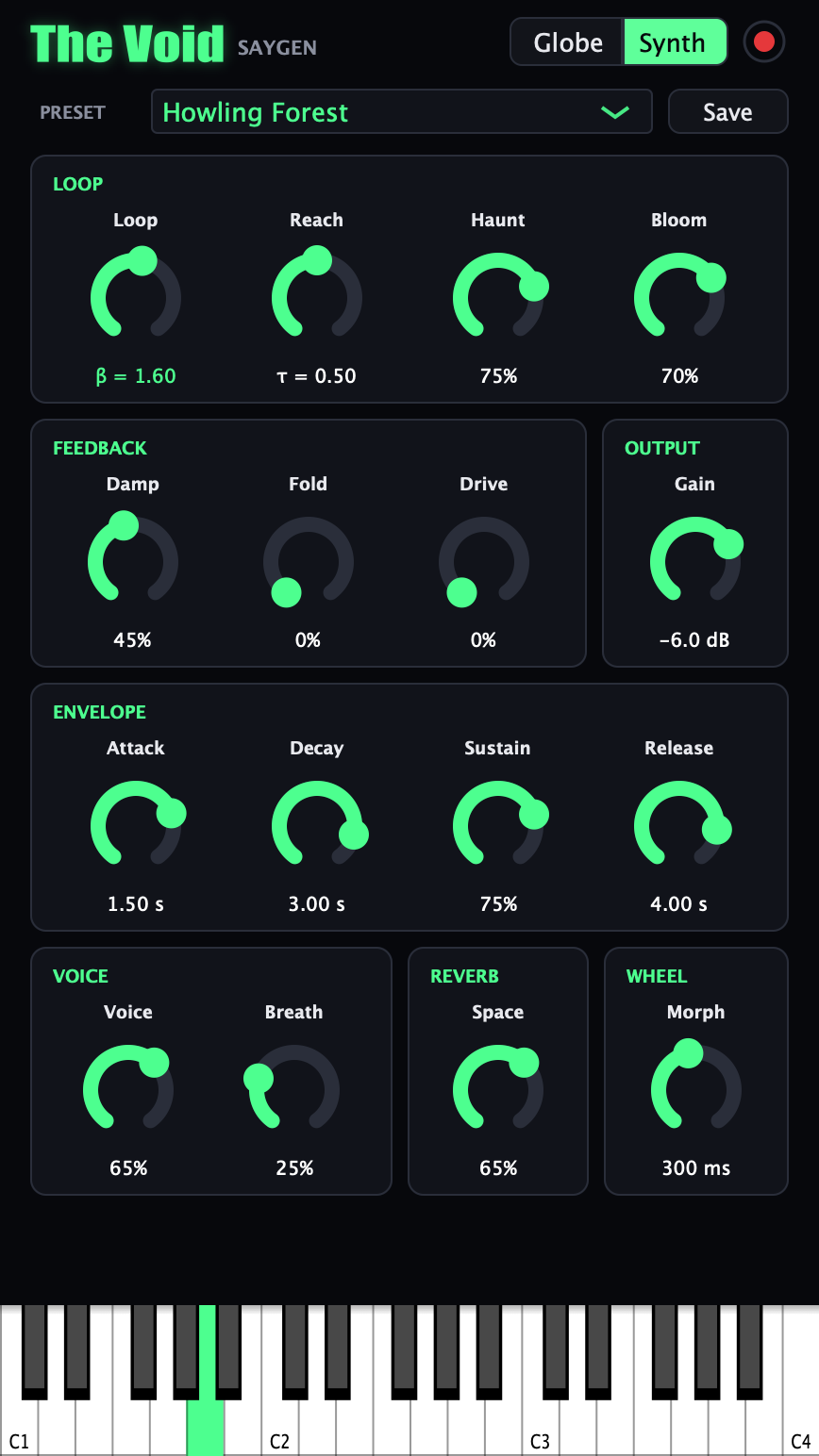
Every note is a sine that hears its own past: y = sin(ωt + β·F(y(t − τ))). At Loop 0 it's a pure tone; turn it up and it howls, sings and finally comes apart into chaos.

Synthesizer · AU · VST3 · Standalone
Haunting voices from a loop that feeds on itself. One formula sings back into itself, through dark vowels and ghostly whispers, in a large, dark hall.
macOS 11 or later, Apple silicon and Intel · Windows 10 or 11, 64-bit
How it works →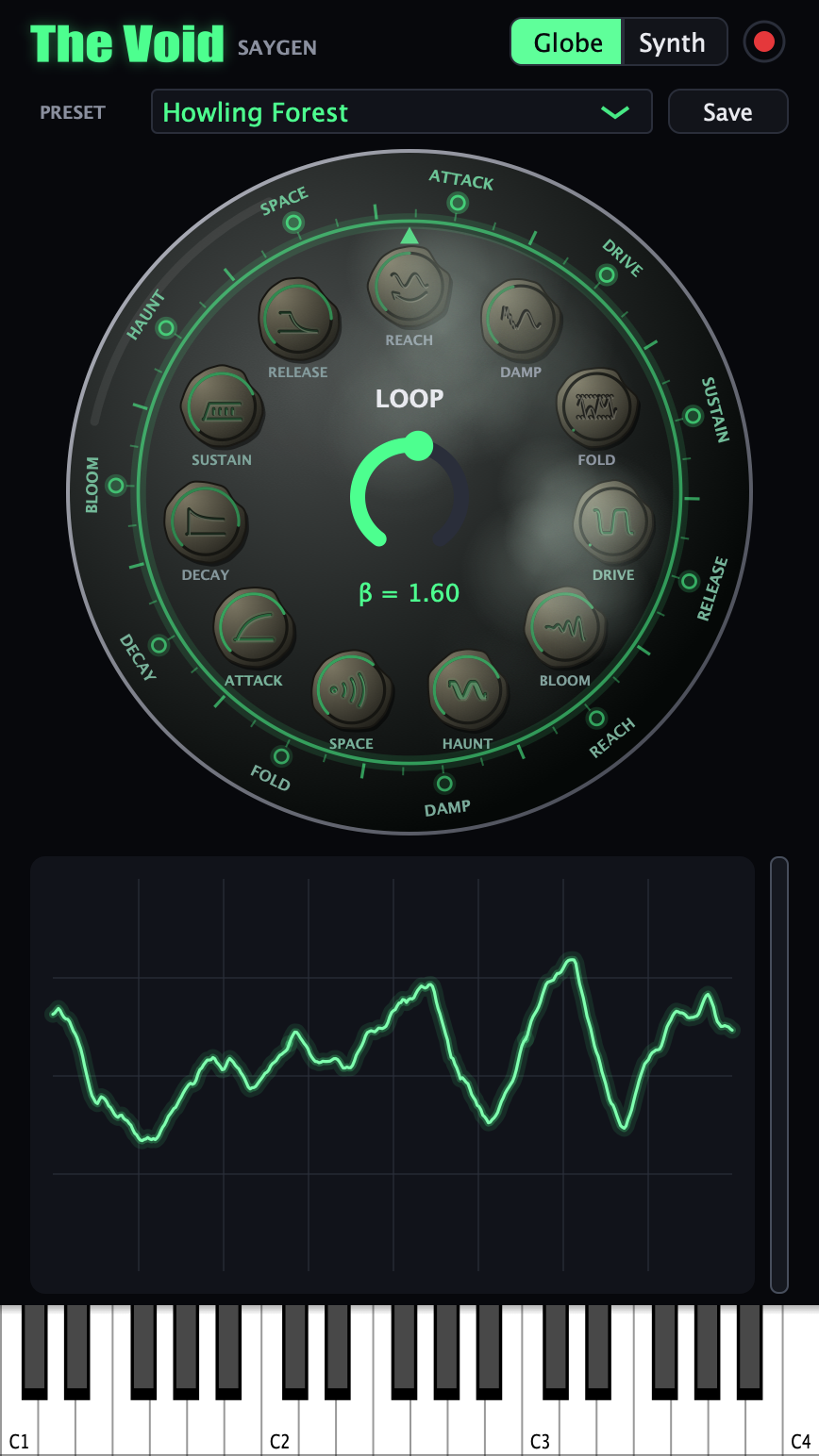
Douglas Hofstadter called it a strange loop: something that, followed far enough, arrives back at itself. The Void is built on one. Each note listens to what it just played and bends itself by it, and the result sounds less like an oscillator than like voices calling from somewhere far away.
Every note is a sine that hears its own past: y = sin(ωt + β·F(y(t − τ))). At Loop 0 it's a pure tone; turn it up and it howls, sings and finally comes apart into chaos.
Voice sends the loop through slowly drifting vowels, oo, oh, ah, a different one on each side, so it sounds like a choir. Breath adds whispered air, and past halfway it becomes ghosts whispering all around you.
The wheel round the glass globe spins faster the more notes you play, reshuffling the feedback chain as it goes. Play slowly and the sound settles; play fast and it storms.
Haunt adds copies of the loop either side and an octave down, each drifting on its own, into a pad. Bloom lets the loop grow with the envelope, so notes open up as they swell.
Howling Forest, Choir of the Lost, Whispers, Siren in the Dark, Event Horizon and more. Save your own sounds as presets with one click.
The window is 9:16. On a Mac, the round button in the header films it with exactly what you play, ready to post to Instagram.