The function wheel
Thirteen functions from analysis, fractals, number theory and chaos theory. Related functions sit side by side and share a colour, and each slice shows the mathematician behind it.

Synthesizer · AU · VST3 · Standalone
A synthesizer that plays math. Pick a function on the wheel, from Fibonacci to the logistic map, and its values become the waveform you hear.
macOS 11 or later, Apple silicon and Intel · Windows 10 or 11, 64-bit
Watch it play →Most synths start from a sine, a saw or a square. MathSynth starts from mathematics: prime gaps, the Cantor staircase, Gödel numbers, the Collatz sequence. Each one has its own voice, and the wheel lets you move between them while you play.
Thirteen functions from analysis, fractals, number theory and chaos theory. Related functions sit side by side and share a colour, and each slice shows the mathematician behind it.
The oscilloscope locks to each cycle, so the waveform stands still while you play. The window is 9:16, the shape of a Reel, ready to screen-record.
Math changes each function's constants: the logistic map's r, Weierstrass's a and b, the base of a sequence. Smooth rounds off the hard edges.
At 1x one cycle of the function plays per note, in tune. Slow it down in octave steps and the numbers turn into rhythms and textures.
A resonant filter, envelope and glide. The mod wheel can sweep Math, Smooth or the cutoff, and Learn maps it to any controller.
Keys, leads, funk and soul, plucks, bass and rhythm to start from. Save your own sounds as presets with one click.
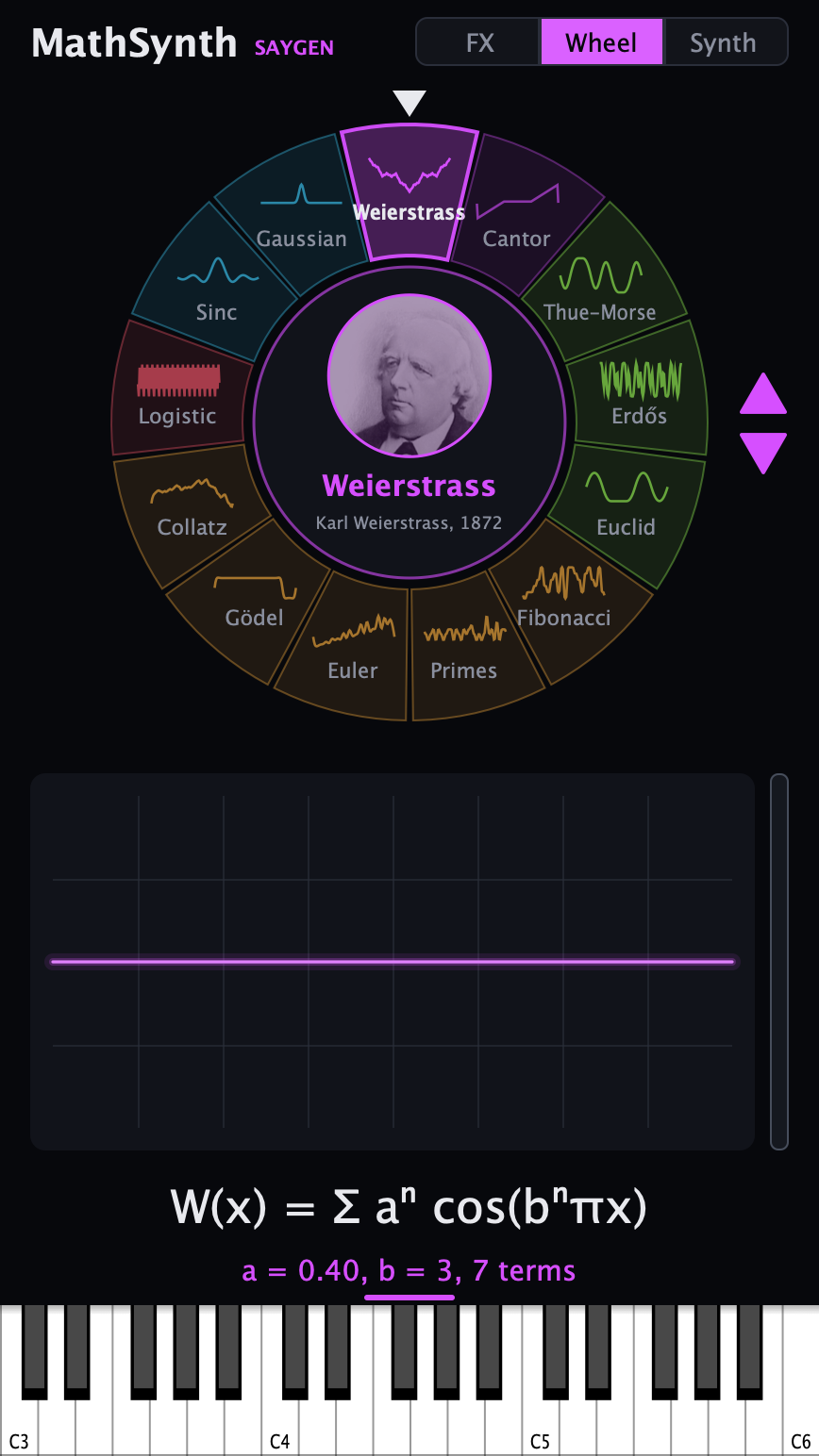
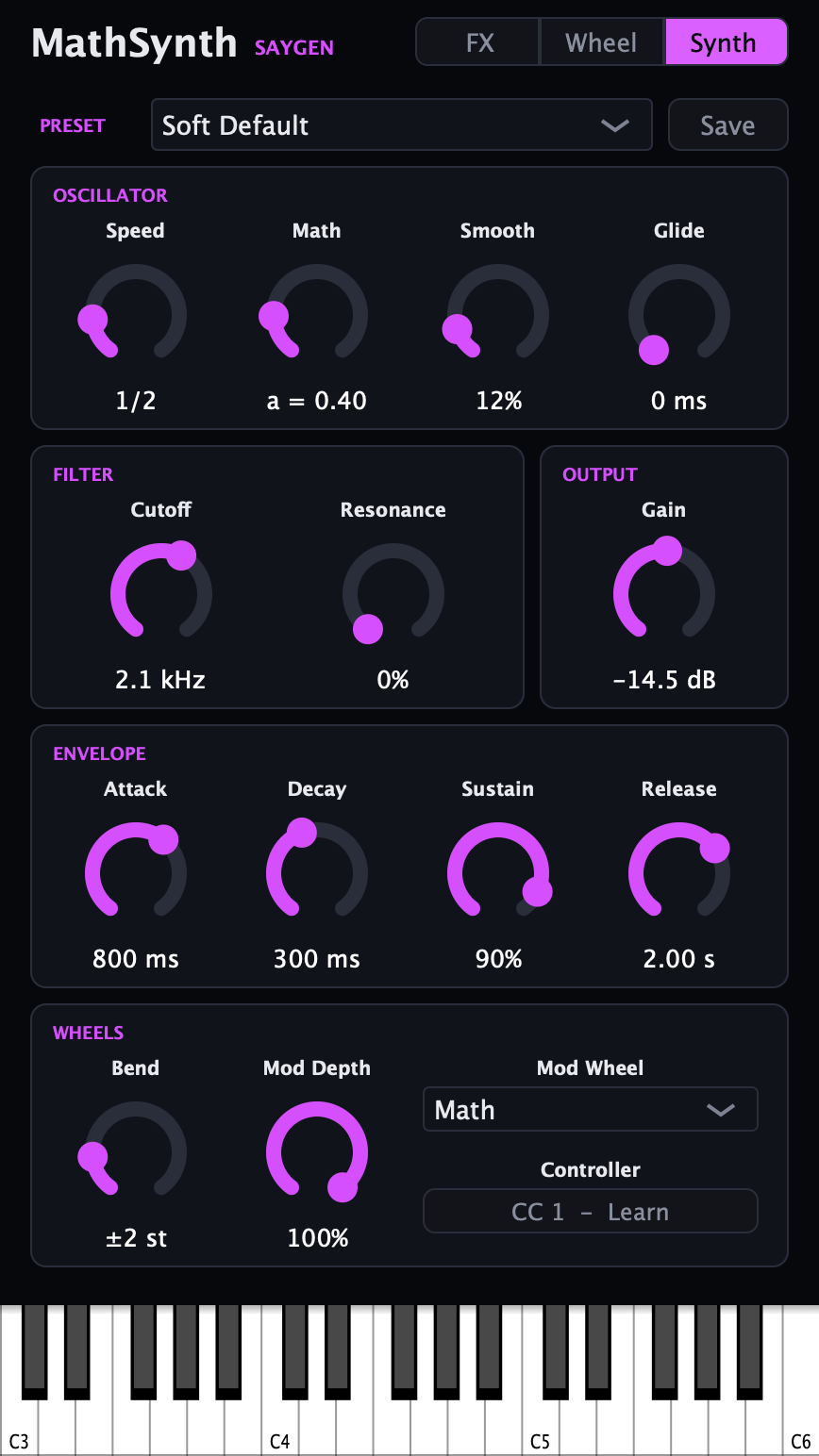
In wheel order. Each function becomes a single-cycle wave: a curve plays its shape, a sequence plays its terms as steps. The Math knob changes each one's constant.
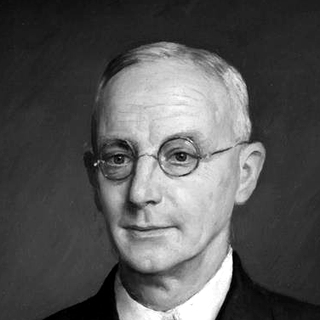
E. T. Whittaker, 1915 · Analytic
sinc(x) = sin(x) / x
A sine wave divided by x: one tall peak with ripples fading out on both sides. It's the shape of a perfect click, the building block of digital audio.
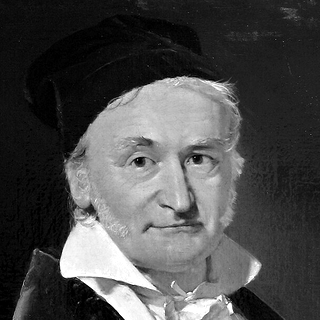
Carl Friedrich Gauss, 1809 · Analytic
f(x) = e^(−x² / 2σ²)
The bell curve from statistics. As a wave it's one smooth pulse per cycle, mellow when wide and buzzy when narrow.
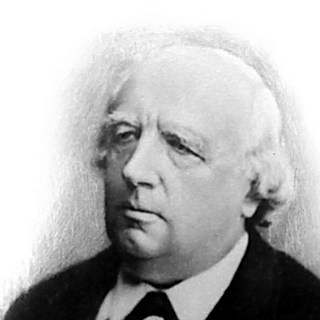
Karl Weierstrass, 1872 · Fractal
W(x) = Σ aⁿ cos(bⁿπx)
A stack of cosines, each faster and quieter than the last. It's continuous everywhere but has a corner at every point, so it sounds bright and jagged.
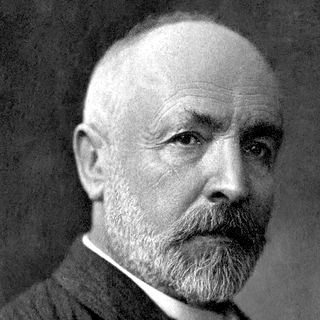
Georg Cantor, 1884 · Fractal
C(x/3) = C(x) / 2
The devil's staircase: a ramp that climbs from 0 to 1 while staying flat almost everywhere. Each step of the Math knob adds another level of stairs.
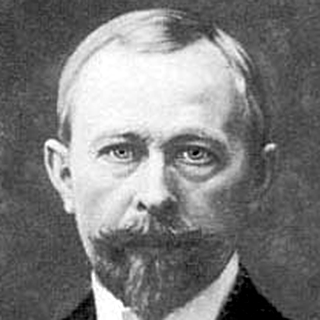
Axel Thue, 1906 · Binary sequences
t(n) = popcount(n) mod 2
Count the 1s in n written in binary: even gives +1, odd gives −1. The pattern never repeats itself three times in a row, so it sounds balanced but restless.

Paul Erdős, c. 1932 · Binary sequences
|x(d) + x(2d) + … + x(kd)| > C
A sequence of +1s and −1s built so its sums along every stride stay as small as possible. Erdős asked whether they could stay bounded forever; Terence Tao proved in 2015 they can't.
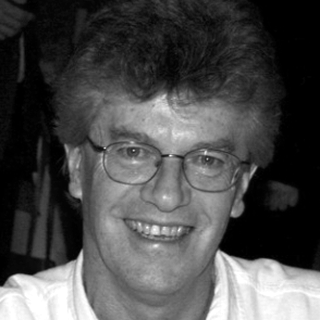
Godfried Toussaint, 2005 · Binary sequences
onset(j) = ( j·k mod n ) < k
k beats spread as evenly as possible over n steps, the rhythms Toussaint found in music worldwide. Slow it down with Speed and the wave becomes a drum pattern.
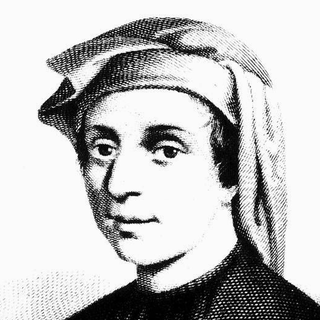
Fibonacci, 1202 · Number theory
F(n) = F(n−1) + F(n−2) mod m
Each number is the sum of the two before it, keeping only the remainder after dividing by m. That makes the sequence loop, and MathSynth plays one loop per cycle.
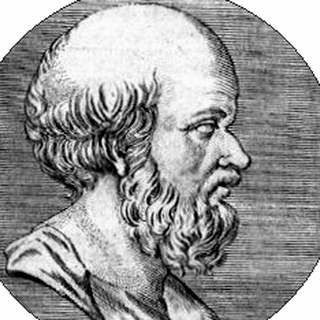
Eratosthenes, 3rd c. BC · Number theory
g(n) = p(n+1) − p(n)
The gaps between consecutive prime numbers. Nobody can predict the next one, so the wave is irregular without being random.
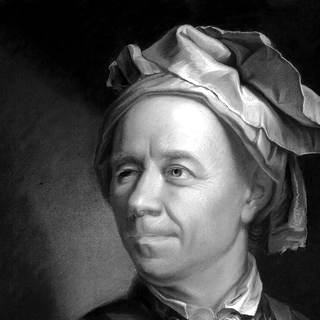
Leonhard Euler, 1763 · Number theory
φ(n) = #{ k ≤ n : gcd(k, n) = 1 }
φ(n) counts the numbers up to n that share no factor with it. It spikes at every prime, so the wave is a jagged climb.
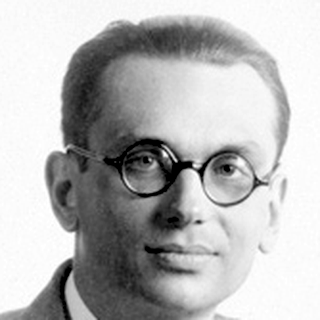
Kurt Gödel, 1931 · Number theory
G = 2^a · 3^b · 5^c · 7^d …
Gödel turned every formula into one number by raising successive primes to each symbol's code. MathSynth plays the codes for the number n, a pulse that narrows as n grows.
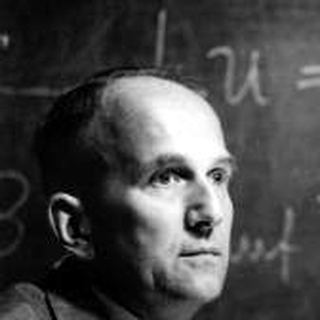
Lothar Collatz, 1937 · Number theory
n → n/2 or 3n + 1
Halve n if it's even, otherwise triple it and add 1, and repeat until you reach 1. Nobody has proved every number gets there; the wave is the whole trip.
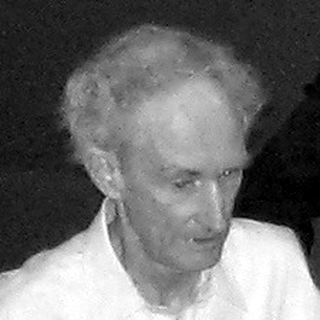
Robert May, 1976 · Chaos
x → r x (1 − x)
Robert May's model of a population that grows until crowding holds it back. As r rises it settles on 2, 4, then 8 values before breaking into chaos.
Portraits from Wikimedia Commons. Toussaint (Godfried Toussaint), Collatz (Konrad Jacobs) and May (NBeale) are adapted from CC BY-SA photographs, Erdős (Kmhkmh) from a CC BY photograph; the rest are public domain.